
Borders Beyond Words: Grensgeval on the grammar of the circus

What do words do in circus? What does circus do with words? Language brings fascination as it provides clarity; words remove distances, as they complicate relationships; this duality of language is its beauty and its necessity. But perhaps duality is not entirely fitting to address the role of language in how we experience, create, present, and engage with circus. It may not be a matter of speaking or staying silent; a matter of forming words or of using one’s body to express an idea. The either/or may be the wrong premise; we may gain more from considering circus as located anywhere on the spectrum between the worded and the un-worded.
Valentina Barone and I sat down with Mahlu Mertens, one of the co-directors of the Flemish company Grensgeval, whose circus creations can be found on this spectrum. We discuss how language, words, and overarching approaches to a grammar of performing arts impact their work. Operating at the crossroads of circus and theatre, mixed with other artistic expressions, their work stages strong visual and sensory material. But what role do words play in the distinctive oeuvre of Grensgeval?
Valentina Barone: Mahlu, can you share a bit more about how you are currently exploring words and circus?
Mahlu Mertens: We follow two main paths. First, we often work in interdisciplinary teams. Everyone thinks they are speaking the same language—usually English—but words carry different meanings in different fields. For example, “poetic” meant something very specific to us from theatre, but it took weeks to realise our sound designer interpreted it differently and resisted the idea of composing something poetic.
We were in a space of prolonged misunderstandings until we unpacked what we meant by it. Similarly, circus artists often resist "acting" because they associate it with something fake or grotesque, so they are not present on stage as we want them to be. But as theatre directors, we know there are many authentic, subtle styles of acting.
Elena Stanciu: That is a very interesting syntagm—‘prolonged misunderstandings.’ Are they always frustrating, or can they be creatively productive?
MM: They can be productive if everyone’s aware there is a misunderstanding and is open to exploring it. But if you think you understand each other and you do not—it is just frustrating and time-consuming. So in our multidisciplinary teams, it is important to make sure we have a common language, that we don’t use the same word but with different meanings.
In theatre—and also, in literary studies, my background as well—you have a very elaborate vocabulary to talk about what’s happening, what you are doing. In literature, for example, you talk about the focaliser, the narrator, the temporal setting, or the pace at which time moves in a novel. In poetry, you have technical terms to describe structure, rhythm, and form, but also a rich vocabulary to talk about the poem’s style and effect.
It is the same in theatre. We talk about the intention of a scene, the motivation of a character, and concepts like dramaturgy—horizontal or vertical—development within scenes, and so on. There is a shared language to describe both the mechanics and the meaning of a performance.
ES: What does circus bring to this?
MM: Circus has its own vocabulary, of course, and it is largely centred on technique—on tricks or the names of specific disciplines. Which is absolutely valuable. We have educated ourselves in that technical language, but we noticed that it is often tied to what you do—not why you do it or what it means.
However, the field is shifting. Where circus used to be more of a sequence of five-minute acts—entertaining and impressive, but without a cohesive narrative or emotional arc—artists are now creating performances that aim to hold an audience for 40 minutes or more, often with a single discipline or a consistent team on stage throughout.
To do that successfully, you have to be able to talk about what you are trying to achieve beyond just technique. It is not enough to say, “Here are three impressive tricks.” You need more—you need to consider structure, emotion, atmosphere, and intention. And to explore those elements, you need language.
VB: Especially for directors or outside eyes...
MM: Absolutely, for us, as directors, language is crucial. If you are a collective of circus artists who have trained and worked together for years, you might not need as much verbal communication—you can rely on body language, shared experience, and intuitive connection. But directors do not share the artists’ embodied knowledge; we do need language. We need to give feedback, make suggestions, and reflect on what is happening—and for that, we rely on words.
Within circus, while there is a robust technical vocabulary, there is still a lack of language around relationships. And I mean that in the broadest sense—relationships to your discipline, to the person you’re on stage with, to the director (if there is one), to the audience, to the objects you are using, or to the space itself. All of these affect a performance profoundly.
And this idea of relationships—it is somewhere in between technique and content. It is not purely about how you do something, and it is not only about what you are trying to say either. But relationships carry content, and they are shaped by technique. There is a kind of in-between space there that I think is still underexplored in circus.
ES: How do kids respond to your work?
MM: We invite them into rehearsals early. With four-year-olds, verbal feedback is tough—body language tells us more. Seven or eight-year-olds are more verbal, but they interpret instructions literally. We had a funny instance where we invited them to “walk through space,” which is theatre shorthand for engaging with the space, but they started acting and walking like astronauts. If we ask them to “feel each other,” another shorthand for being aware of the energy of others, they start physically touching one another. It is a reminder of how much jargon we internalise in the arts. But in some instances, we create performances with children, and not only for them, so it’s important to teach them this language, to help them feel like professional actors.
ES: It is interesting how kids do not have fixed assumptions and look at things through fresh perspectives. What about the idea of meaning as a fixed or negotiated concept? How do you approach meaning in your work?
MM: Our background in theatre drilled into us: know what you want to convey before you choose the form; not necessarily draw out the beginning, middle and end, but know what you want to say with the piece before you start giving it shape. But working in circus and studying posthumanism and new materialism has changed that. It is entirely possible—and sometimes desirable—to start from a material or object and arrive at content and meaning. I believe humans are still needed to narrate stories, but in a time when we are decentering the human, it's crucial to rethink our relationships with objects, nature, and the non-human world.
For Irroottaa, we worked with handmade clay balls. It was a collaboration with two architects to design objects that could function in circus without having a circus history per se. Just watching performers interact with them—dropping, collecting them—created meanings of chaos, space, or feeling overwhelmed. We did not start with a fixed idea for the content; we just explored the material and the object, but it immediately started giving meaning when Willem and Sophie were interacting with the balls on stage, and a multitude of images were created.
In Murmur, we reversed the usual dynamic—sound didn’t move the performer; the performer moved the sound. This required aerial straps and rigged speakers that looked like faces, which made them feel like co-performers.
ES: That ties into design and form—do you think audiences search for shapes or forms? Can “meaning” present itself as a shape-led experience for a circus audience?
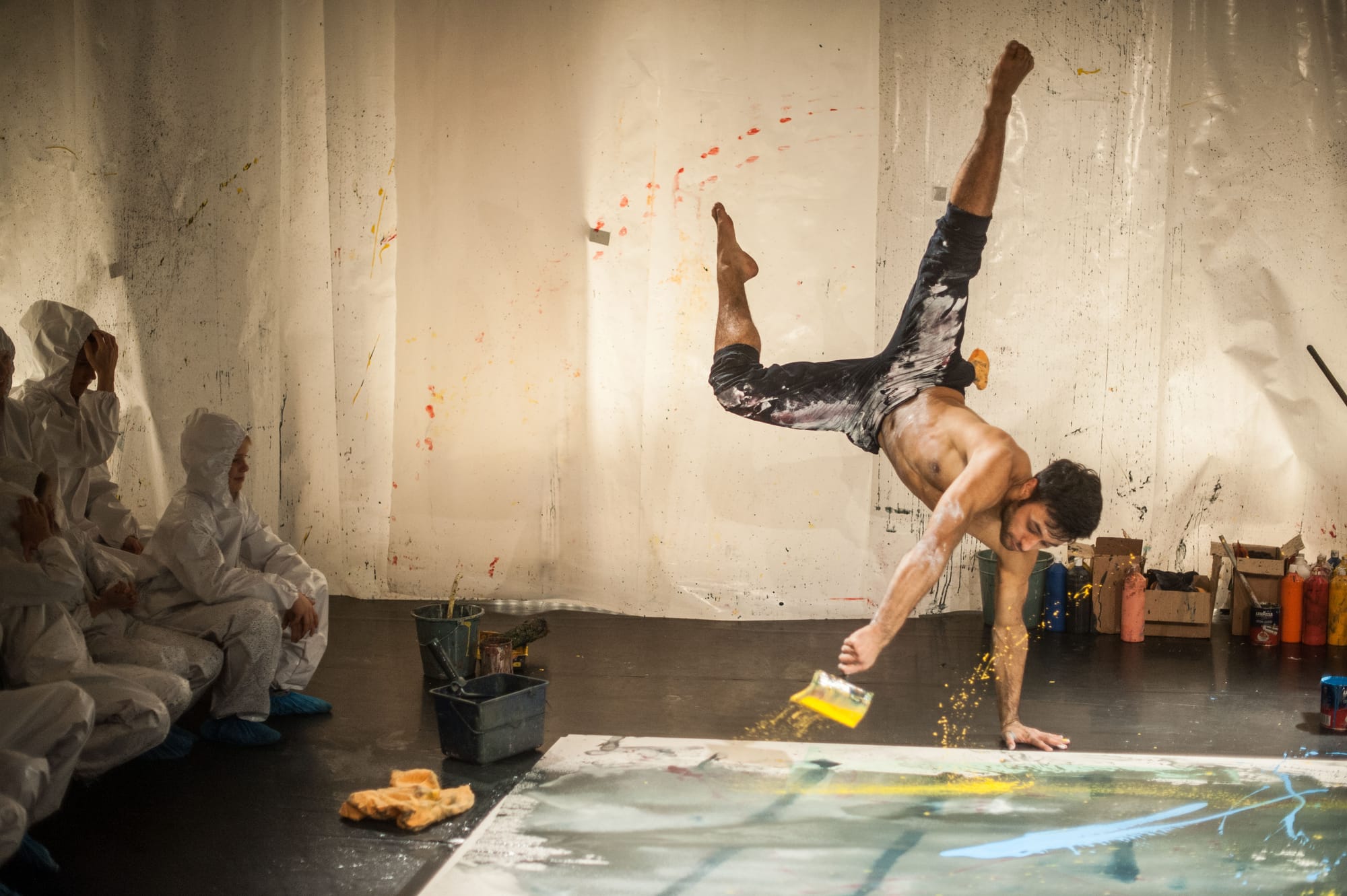
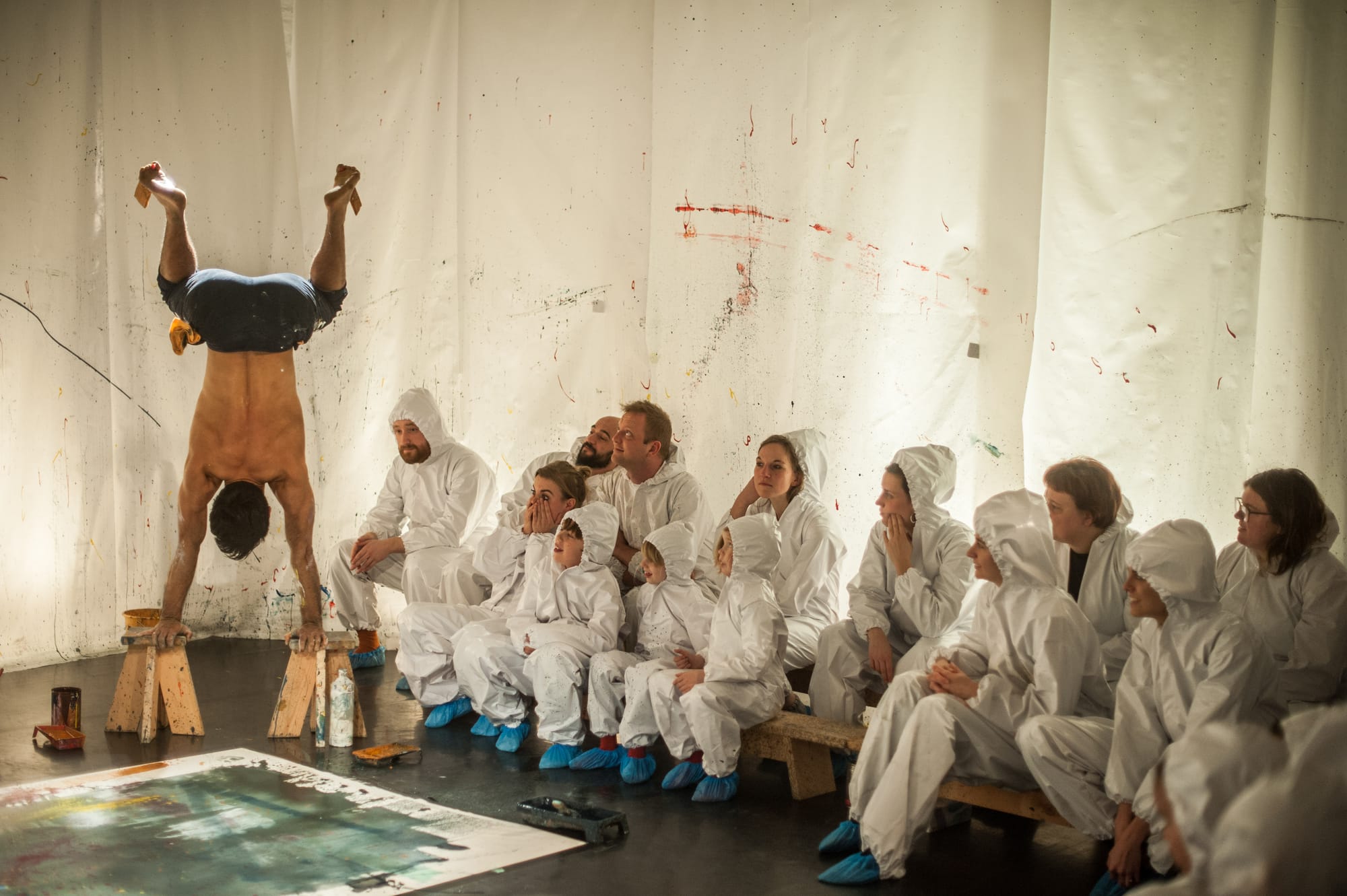
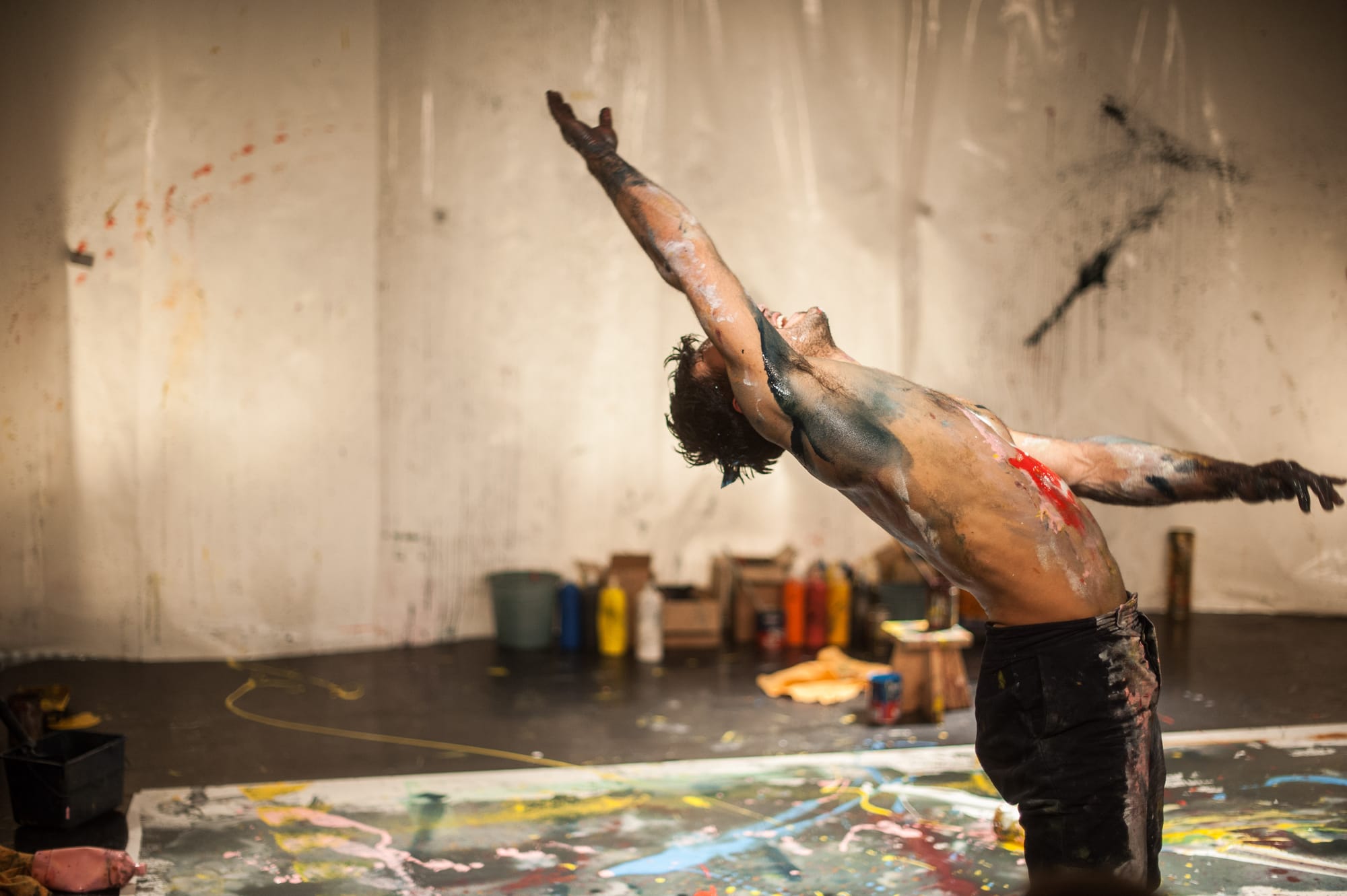
MM: Yes. People crave order and logic; even in abstract pieces, they will order what they see on stage to draw meaning from it. In terms of shape and more conventional considerations of aesthetics, we have learned to shift from calling things "beautiful" to calling them "satisfying." Something considered ugly can still be satisfying if it conveys the right feeling. We work with objects that are not conventionally beautiful; they are brutalist, kind of harsh; or, if we look at the set of PLOCK!, kind of dirty, lived-in. We have these plastic sheets, covered in 8 years’ worth of paint, but they have a story; they are satisfying to be around, and we have different attachments to them.
VB: Could you talk about building a grammar in your shows, or operating with a type of syntax, considering also all these thoughts about form, shape, and meaning?
MM: When adults come to the theatre, they bring expectations. Kids do not. So we work to create a shared grammar—a set of rules that make everyone feel safe to interact and which they can learn quickly, in the space of the performance. We destabilise norms by asking people to take off shoes or wear protective suits. Kids follow, thinking this is just what you do. Adults are surprised.
Similarly, adults have certain ideas about what a good performance looks like, and kids do not. This gives us the freedom to do things differently. One way we interrupt the pre-existing grammar of expectation is by having very creative titles for our performances, which seem to mean something but not quite. It’s interesting when kids ask their parents what a word means, and the parents themselves don’t know—that space of uncertainty and openness puts adults and children on the same level, trying to figure out what’s going on.
ES: Language is a convention, and the words we use reaffirm the conventions, often to assure us, help us trust others or be at ease. Circus has its own conventions, maybe in technique, relationships... How do you explore these?
MM: For instance, in theatre, applauding mid-show is rare. In circus, it is normal. We try to manage that in our work depending on the mood we are building, and we do this by establishing certain codes for the audience and letting them know what is ok to do quite early in the performance. In some of our shows, members of the audience become performers themselves, so it is very important to have this trust—that they will not be mocked, that they have a meaningful contribution, and that they are safe to participate.
We encode these messages in the work, and audiences are usually great at catching the code. Similarly, asking for and receiving consent, within the space of the performance, in real time, is a subtle thing—we sometimes have to lift kids, as part of their participation. We can’t always ask for consent before the show, so we must create codes with the audience so they understand what they become a part of, and can consent to it. These are non-worded exchanges; we do not say much, but we exchange quite a lot, as part of this syntax of performance, if you will.
A shorter version of this interview is part of the publication Popcorn: Circus & Words – dynamic perspectives on circus. Explore the full issue HERE
Popcorn: Circus & Words – dynamic perspectives on circus is a publication of the Flemish circus arts centre Circuscentrum
EDITOR-IN-CHIEF Liv Laveyne
EDITORIAL Valentina Barone, Liv Laveyne, Maarten Verhelst
COVER DESIGN & ARTWORK PJOTR.be
CO-WRITE THIS ISSUE Valentina Barone, Evelyne Coussens, Katrijn De Bleser, Jasper Delva, Karlien De Savoye, Wouter Hillaert, Leonie Maes, Lina Matthys, Liv Laveyne, Tom Permentier, Elena Stanciu, Maarten Verhelst
IMAGES Cie Pol & Freddy, Stefan Gevaerts, Delphine Lebon, Anna Barclay Arnolfini, Matthias Ziemer, Carla Dacal, Jakob Rosseel, Bart Grietens, Maryan Sayd, Andy Paradise, Tom Van Mele, Michiel Devijver, Circuscentrum, Jan Castermans, Compagnie XY, Roberto Magro, Victoriano Moreno, Lien De Trogh, Sepideh Favardin, Natalie Glas, Heroen Bollaert (for PERPLX)
Every year, Circuscentrum zooms in on a single theme that resonates within the circus sector and beyond. We bring together knowledge and perspectives, draw connections, and open the debate. Through analyses, opinions, interviews, and good practices, we explore what is moving today, where the circus comes from, and which directions it can take.
The 2026 Circuscentrum theme focuses on DEMOCRACY