
Words are a Circus Discipline: A dive into the practice of Laura Murphy, Kathrin Wagner and Roxana Küwen Arsalan

Physical languages usually distance themselves from spoken words and emphasise, through gestures and movement, the magic of non-verbal communication and understanding. In a broader sense, they do not necessarily need words, creating a silence filled with significance on their own. However, what happens when circus artists perceive words and their voice as a vehicle for their artistic practices? What are the implications and the role of talking on stage in their dramaturgy choices? And what does it mean in terms of them as a physical technique combined with their circus practices?
I asked three circus artists, Laura Murphy and Nicole A’Court-Stuart of Contra Productions, Kathrin Wagner, and Roxana Küwen Arsalan, why and how they use words on stage. Their responses reveal the significant power of words in their current dramaturgy choices. Leaving aside the impostor syndrome of “not being an actor”, in contemporary circus, words on stage can become a necessary tool, often combining a personal political gaze with a way of addressing universal problems. Between urgency, direction and definition, conceptually they can be a powerful augmenting dimension that expands their artistic practices. Then, words can be intended as physical language itself, deeply influencing their circus techniques and apparatus relationships.
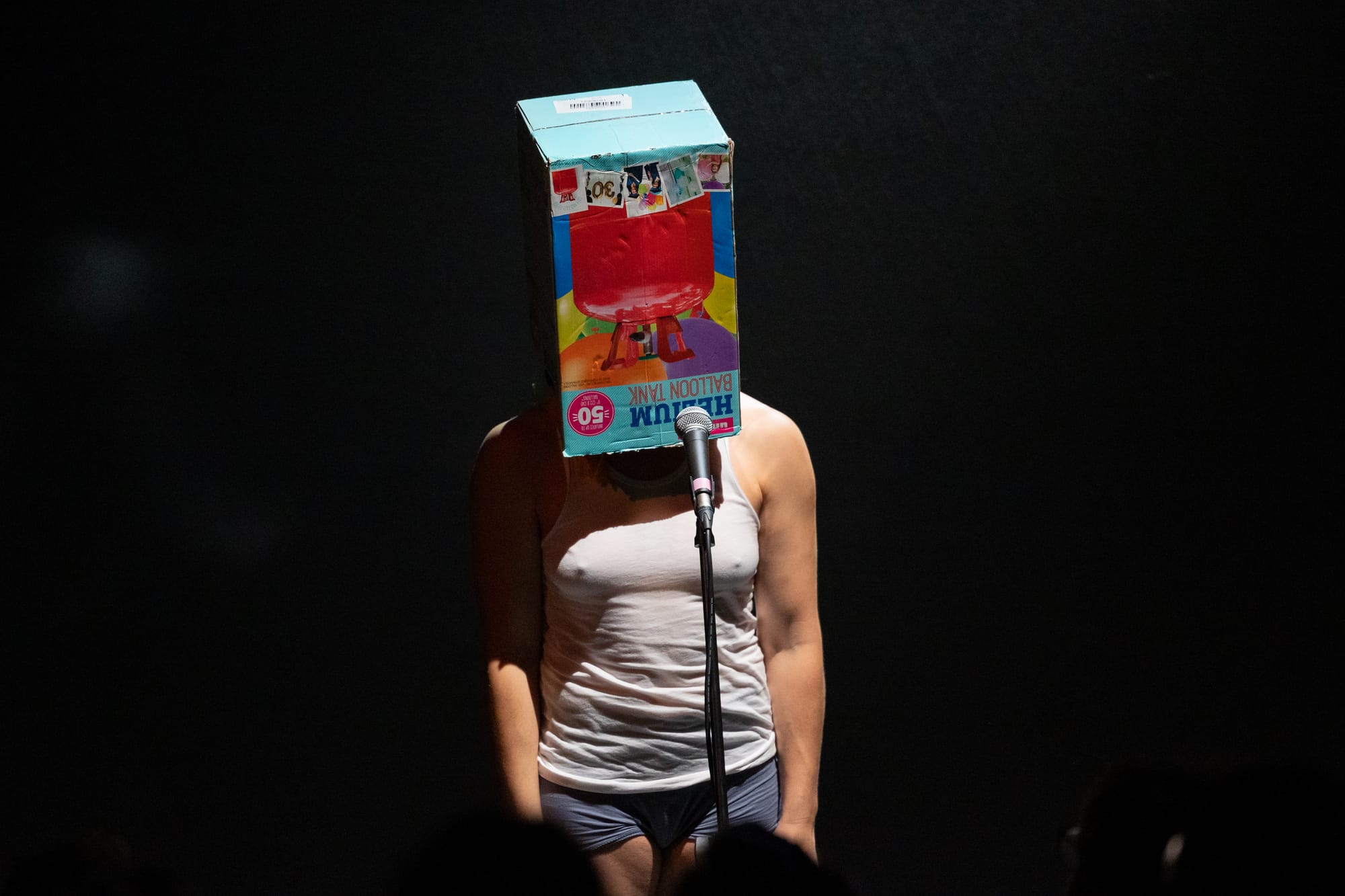
Laura Murphy: I see circus and words as different languages in dialogue in my artistic practice, where each other can express things, the other cannot, especially considering the political meaning of aerial performances addressing themes as perfection, gender and labour. I use them together to convey their message, and the interaction between non-verbal and verbal elements provides context for each other. We can also qualify them as a circus medium, noting that playing with words requires virtuosity, practice, training, and editing, like physical acts.
Text helps contextualise the physicality in my aerial practice, acting as a bridge to new choreographic approaches. In Contra, for example, the aerial element helps contextualise the verbal monologue, especially regarding patriarchy and the objectification of bodies. In A Spectacle of Herself, they also offer a perspective on the internal landscape, conceptually meeting the external physical body on stage. They can be instructive, allowing me to tell the audience how I wish to be perceived, likening it to “drag without makeup”. My use of text holds a political and ritualistic quality. They enable me as an artist to enact conflict and convey how I wish my body to be perceived and connect my performance to wider socio-political events.
My monologues are highly technically structured, like a song, and I learn lines musically, visualising words and their meanings existing in space. I think of lip-sync as a layering game where I have the opportunity to reclaim, criticise, re-contextualise and/or re-present voices through the container of my own body (and in dialogue with the curated performance environment).
For example, through some of the lip sync scenes in Contra, I layer misogynistic voices with my naked body, drawing attention to violence and degradation presented through humour. In A Spectacle of Herself, I parody Elon Musk: lip-syncing his voice whilst zooming around the stage on a gold hoverboard, reminding the audience of his commitment to technological development and his desire to conquer space at any cost. In this way, the displacement and decontextualisation of the voice through lip-sync becomes a method for responding to wider social and political dialogue, channelled through, and in partnership with, my own body.
Nicole A’Court-Stuart: Words on stage reclaim the context and frame how a body is read in that space, emphasising the choice to use or not use silence. In Laura’s approach, the use of text aligns with magic, like sleight of hand or illusion, by creating instructions that guide the audience’s focus and frame of mind. Even the lip-sync can be seen as a levelling effect, creating a parallel world where the artist’s own voice and other powerful voices coexist.
Terrence McKenna says telepathy exists through “small mouth noises”, reinforcing the magical quality of words. His presence as a voice-over in A Spectacle of Herself embodies the shaman clown archetype, representing an outsider who returns with knowledge and provides a self-critical perspective on idealism versus power structures.
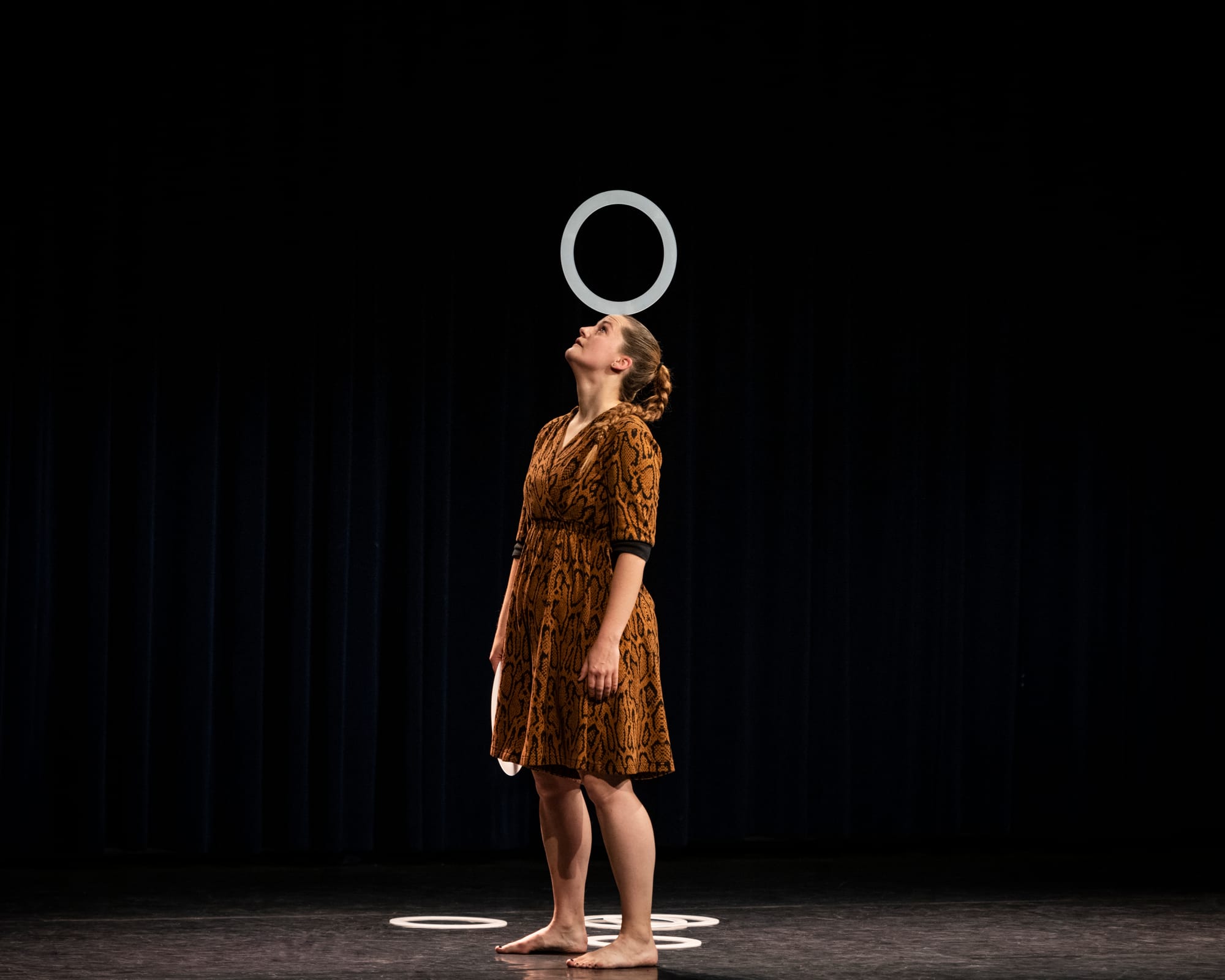
Kathrin Wagner: Using my voice has made me find my identity as an artist. Parallel to my love for juggling, I followed my passion for language as well as its relation to cultural studies, which is what sparked my interest in spoken word as an art form. The more I got involved in poetry, the more similarities I discovered to juggling. Despite wanting to keep spoken word separate from my circus life (who was I kidding), there was too much untapped potential waiting to be explored.
Learning about aspects involved in performing poetry led to a deeper understanding of my ring juggling practice. Joining poetry slams - where props are generally not allowed - taught me to express myself through my voice and shifted my focus onto my body language. I learnt to live an experience on stage instead of carrying out what had been rehearsed. In the process, I gained self-confidence and conscious presence. Introducing spoken word to my circus practice has made my work more profound, detailed, and multifaceted.
In the creation of I Was Told., my urge was for spoken word and juggling to exist parallel to each other, whilst being interwoven. To me, talking on stage is very similar to creating juggling sequences. Improvising juggling as well as interacting with the audience requires great timing, reflexes, trusting your skills and experience to make spontaneous decisions, making room to surprise yourself and each other. Having two disciplines that can co-exist means they have the potential to enrich each other, be dependent on each other or in turn change the audience’s perception. Crafting a poem follows similar rules as creating a juggling piece.
Intonation is the rhythm that can be seen in a juggling pattern. Changing small variables throughout is where contrasts appear, and the stories we tell become more detailed, certain moments are highlighted, and there is room for interpretation. Examples would be the height of throws, the pitch of a voice, tempo and pauses. Using a simple pattern as a baseline for a poem establishes parallel rhythms in interplay. Each can put emphasis on the other, shift the audience’s focus, add details to a story or express something else entirely.
In I Was Told., for example, I restart one of the poems every time I drop. It implies that what I talk about in the poem itself happens frequently and repeatedly, whilst showing the fragility and risk of failure involved in juggling. Every time I start juggling again, the tension rises, and the audience focuses on both my rings and my words. After the final catch, there tends to be a collective exhale followed by empathetic excitement. They want to see me succeed because everyone can relate to making mistakes and trying again.
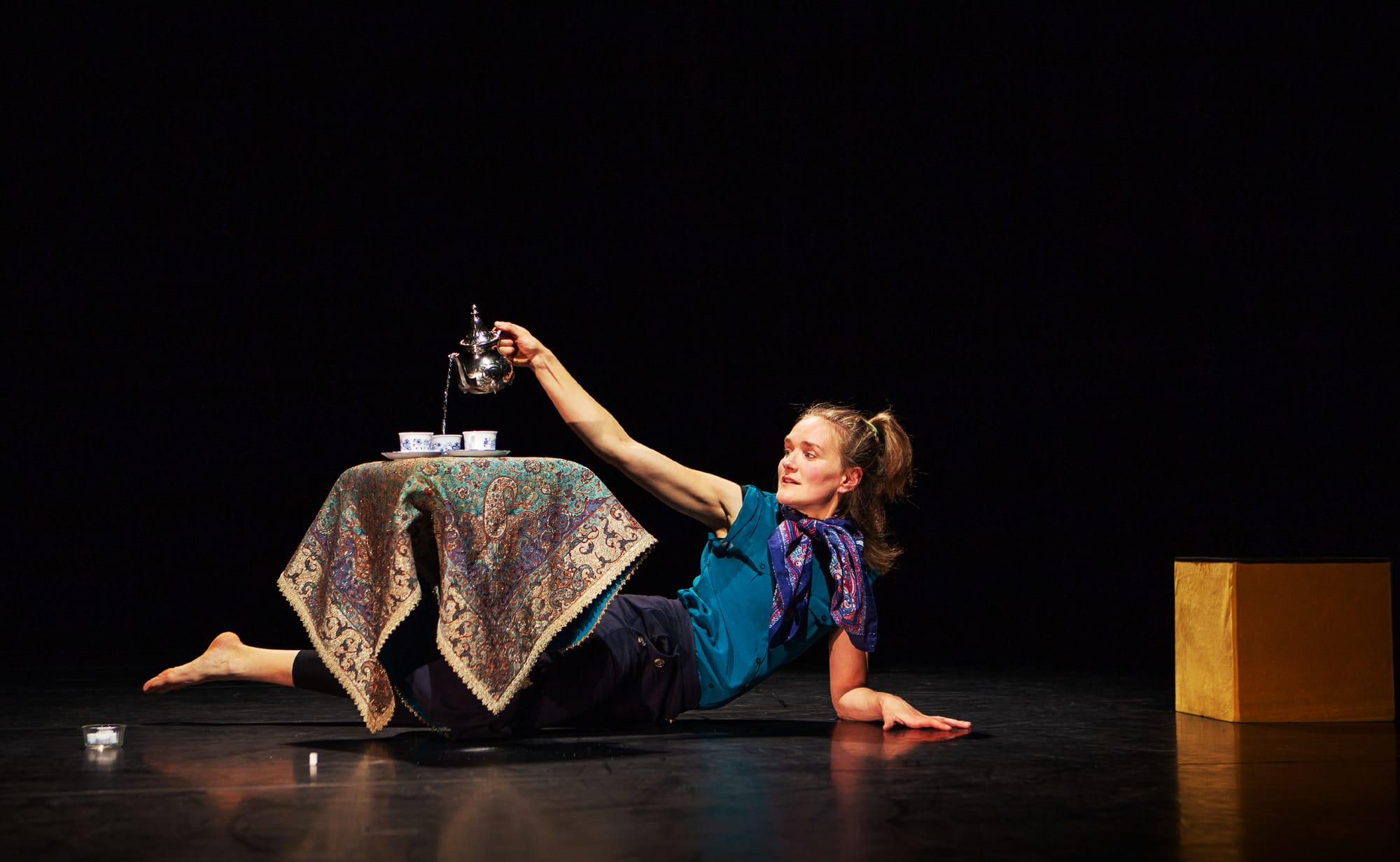
Roxana Küwen Arsalan: I see language as a medium, akin to a circus technique, through which movement and gestures can be manipulated. Both using and not using words should be seen as deliberate artistic decisions, rather than one being more “normal” than the other. It is the cultural context that often influences perceptions of using words in circus.
In France, where I live, for example, language as part of the performance surprises no one. Using words on stage stems from my performance art education at Fontys, which emphasised the “realness” of telling a story and using available means to achieve a better level of communication. I use language as a technique for precise storytelling and audience interaction. In my foot juggling duo with Ariane Oechsner, Play Nice and in my solo OMÂ, words are part of the choreography, complementing or contrasting with movements. Even noticing their absence during rehearsal feels like something is missing.
In OMÂ, the decision to use specific words from specific languages is deeply personal and influences its dramaturgy, sometimes leading to unconventional choices. Playing in different languages also allows them to be seen as integral and equal elements as objects, sounds, or music, which can evoke different associations and travel experiences for the audience. It also provides connection, keeping the performance fresh with an emotional approach tied to each respective language.
Addressing questions directly to the spectators creates a shared space where communication develops naturally. I deliberately choose precise words in provocative or political segments, inviting the audience to reflect in real-time.
Working with words involves familiar elements from juggling, such as rhythm, and I find it helpful to think of them in a juggling manner; integrating words and considering how and where they are spoken has become as profound as other circus techniques, deepening my identity as a circus artist and adding another discipline I need to care for and train. I am still experimenting with seamlessly associating and dissociating the two techniques, which sometimes results in slightly off timing, where it's unclear whether it was the juggling, words, or overall timing that caused it.
This article is part of the publication Popcorn: Circus & Words – dynamic perspectives on circus. Explore the full issue HERE
Popcorn: Circus & Words – dynamic perspectives on circus is a publication of the Flemish circus arts centre Circuscentrum
EDITOR-IN-CHIEF Liv Laveyne
EDITORIAL Valentina Barone, Liv Laveyne, Maarten Verhelst
COVER DESIGN & ARTWORK PJOTR.be
CO-WRITE THIS ISSUE Valentina Barone, Evelyne Coussens, Katrijn De Bleser, Jasper Delva, Karlien De Savoye, Wouter Hillaert, Leonie Maes, Lina Matthys, Liv Laveyne, Tom Permentier, Elena Stanciu, Maarten Verhelst
IMAGES Cie Pol & Freddy, Stefan Gevaerts, Delphine Lebon, Anna Barclay Arnolfini, Matthias Ziemer, Carla Dacal, Jakob Rosseel, Bart Grietens, Maryan Sayd, Andy Paradise, Tom Van Mele, Michiel Devijver, Circuscentrum, Jan Castermans, Compagnie XY, Roberto Magro, Victoriano Moreno, Lien De Trogh, Sepideh Favardin, Natalie Glas, Heroen Bollaert (for PERPLX)
Every year, Circuscentrum zooms in on a single theme that resonates within the circus sector and beyond. We bring together knowledge and perspectives, draw connections, and open the debate. Through analyses, opinions, interviews, and good practices, we explore what is moving today, where the circus comes from, and which directions it can take.
The 2026 Circuscentrum theme focuses on DEMOCRACY