
Jef and Marica’s In Difference: when the kinetic force of a contrast creates harmony

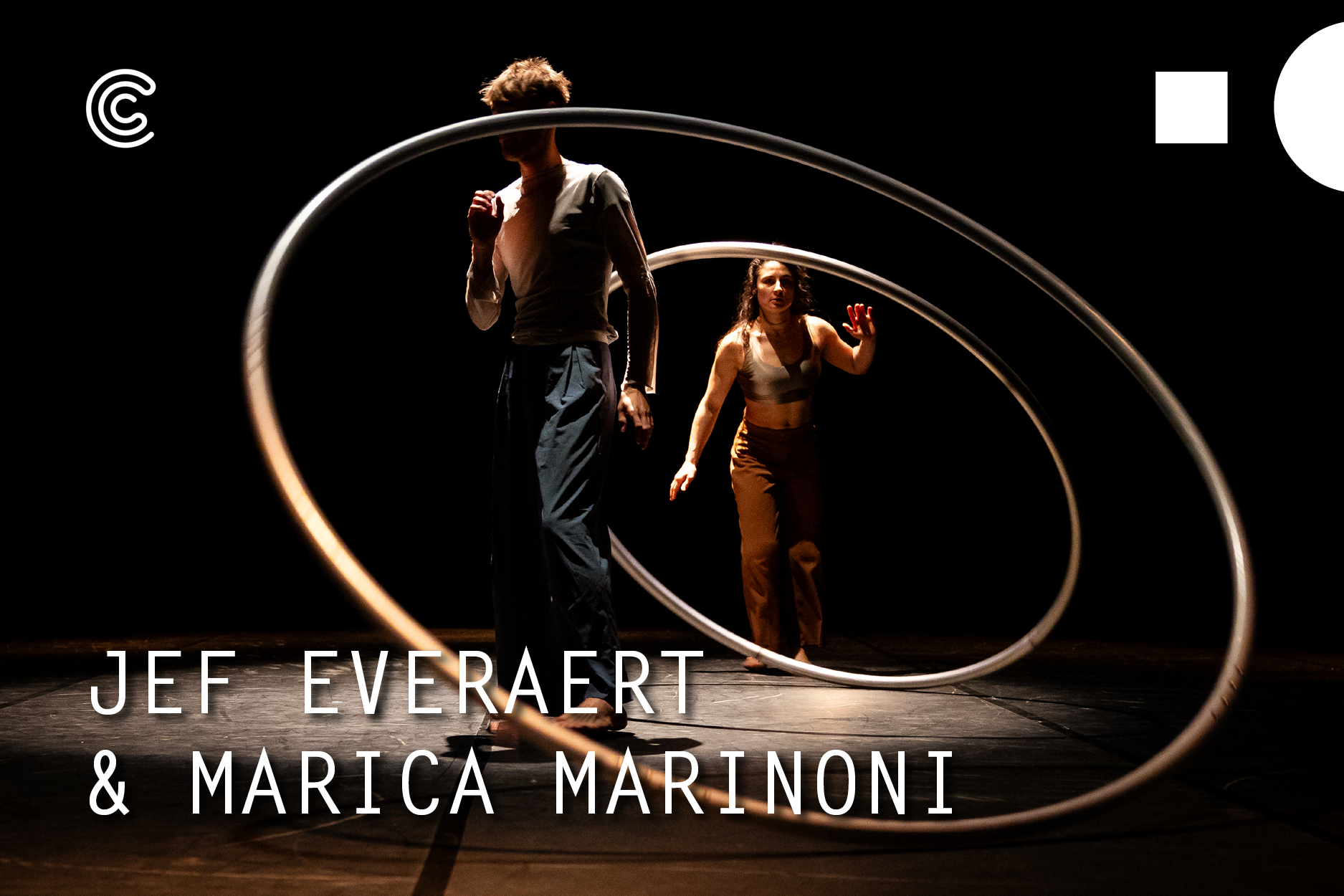
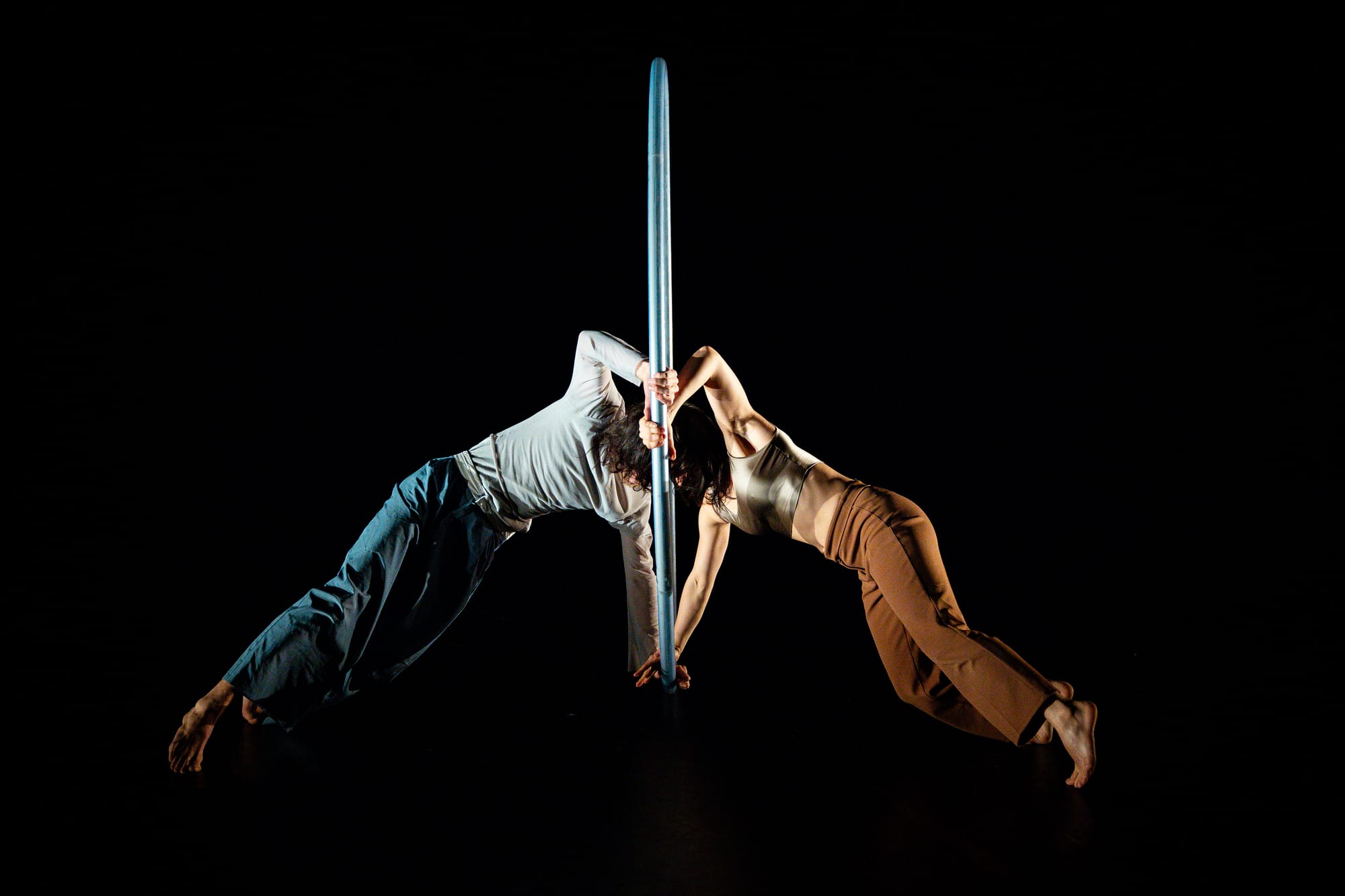
Jef Everaert and Marica Marinoni have transformed their individual technical masteries into a common artistic creation. Both artists attended the same schools, first training at the Flic preparatory school in Turin, Italy, and then graduating from the CNAC in France, establishing themselves as two of the most interesting performers on the European Cyr Wheel scene. Their show In Difference explores how two opposite personalities can share common space and elicit a unique encounter with an apparatus. On stage, the two engage and clash in their search for common ground, with the wheel acting as a third character, fueling a dialogue based on physical, emotional, and human exchange. As gravity teaches us, balance is constantly in motion. In Difference embodies that tension, transforming it into communication. Drawing on the energetic momentum of a kinetic difference, two masterful techniques become a dance between distance and proximity, between stillness and extreme dynamism. For this circusnext interview series, I met the two artists in Turin on their Italian debut.
Let’s start with a key question. How did you meet?
Marica Marinoni: In contemporary circus, those who perform the Cyr wheel belong to a small community within an already niche genre. It’s a very close-knit circle! We both attended Flic circus school in Turin and met there, when Jef was still a student, and I was visiting. We graduated from CNAC three years apart, which isn’t long enough to create a real distance. With Juan Ignacio Tula, the author and founder of Cie 7 Bis, with whom I created my first solo piece, Lontano, in 2022, the generational gap is more evident. With Jef, however, I feel a more equal bond.
Jef Everaert: I started studying Cyr wheel at a Belgian secondary school, two years before joining Flic circus school, so the funny thing is that, despite a five-year age gap and three years of school in between, Marica and I have been practising Cyr wheel for the same amount of time.
What role did mentorship from dramaturgical aids and support from other organisations play in the development of the show?
JE: When you start working as an author, it is essential to have people around you whom you trust. You need guidance, and especially at the beginning of a creative process, it is important to feel supported, to surround yourself with people who care about what you do and back you up. In Difference also stems from the decision to be supported by people with a similar approach, with whom we already had a relationship. For this reason, both Francesco Sgrò and Juan Ignatio Tula were subsequently involved in the work. As for knowing how to manage an artistic project, I, being in my first experience as an author, find that Marica is to me the mentor that those two were to her.
MM: In Difference is my second artistic project, but it’s my first experience as a co-creator and joint lead. In this collaboration, Jef and I are on equal grounds and make decisions together. We have always said that it takes two “yeses” to make something happen, and we stick to this principle. Today, we can say we have won our bet, whereas at the beginning we weren’t quite sure if or how we could work together. The project got off to an uncertain start, but thanks to a series of fortunate and amusing coincidences, it was immediately clear that we had to give it a go.
The first person who clearly pointed out that we should create something together was Francesco Sgrò. A full five years ago, almost as if seeing us work together was a foregone conclusion, a natural step that was bound to happen sooner or later.
The years passed, and we came to July 2022. Jef had just finished Les Échappées and had recently begun work on the year-end collective production. His personal project caught the attention of Cirq’onflex, which contacted him to hear more about his plans. Around the same time, I was on tour in Auch at Circa, performing my solo piece Lontano. We spoke, and from that moment on, it was obvious to both of us that we should take the first steps towards securing support for a joint project.
JE: Thanks to Cirq’ônflex, in 2023, we had the opportunity to take part in three residencies, which we used as research workshops. Firstly, we gave ourselves the freedom to explore and experiment together without the pressure to produce anything, simply to see whether working together was actually a viable option. It was only in January 2024 that we began the creative process for the show.
In the meantime, you decided to apply to circusnext. What motivated this decision?
JE: Of course, we knew what the process involved and were already in touch with people who had gone through it. We were certainly motivated by the thought that this would be Marica’s last chance, given that In Difference is her second solo project, and after their second project, artists applying from France are not eligible anymore.
MM: The process drove us towards research and its evolution. Our ongoing interaction with the jury and the other participants challenged us and motivated us to identify aspects we hadn’t yet recognised. Building a narrative around our research and being able to articulate in words what we wanted to convey on stage was very helpful to better understand which direction to take. Being represented with In Difference among the graduate projects is a huge recognition that has given us legitimacy and visibility. Above all, it has brought us into contact with countries where we had never previously performed individual projects.
In retrospect, I am glad I participated in a well-prepared manner, approaching the process with awareness to achieve artistic coherence. Crafting a bespoke presentation—not to be understood as a finished form—is an exercise in itself. Working on three fragmented scenes made sense for the dramaturgical coherence of the twenty minutes, that is the format required of the selection of laureates.
Although your work is conceptual, you are both highly physical artists who focus on technique. How did you come to establish your creative approach?
MM: At first, I found it very difficult to explain the personal exploration of our relationship on stage. Some people didn’t understand what we were trying to communicate through the technique. They saw the movements, but not their meaning. Personal expression and technical exploration coexist in both of us in a very similar way, and it took a while to bring this quality into focus. Talking about our project often felt reductive to me, whereas performing it in front of an audience always led to more intense reactions. Even today, I find it difficult to put into words what the show conveys on stage.
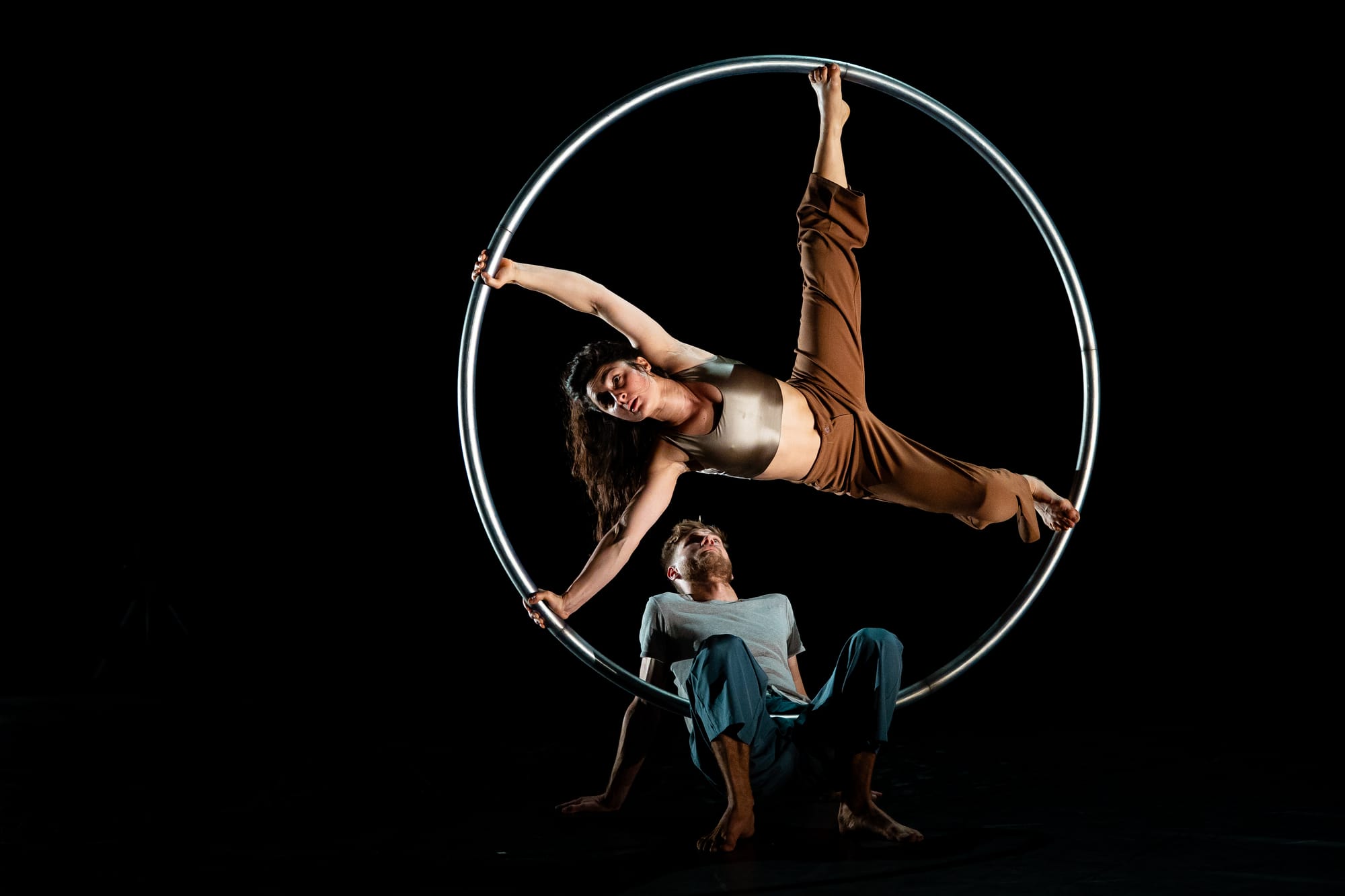
If we were to talk about a triangle of values between you and the wheel: what does the Cyr Wheel mean to you, and what is your relationship with it?
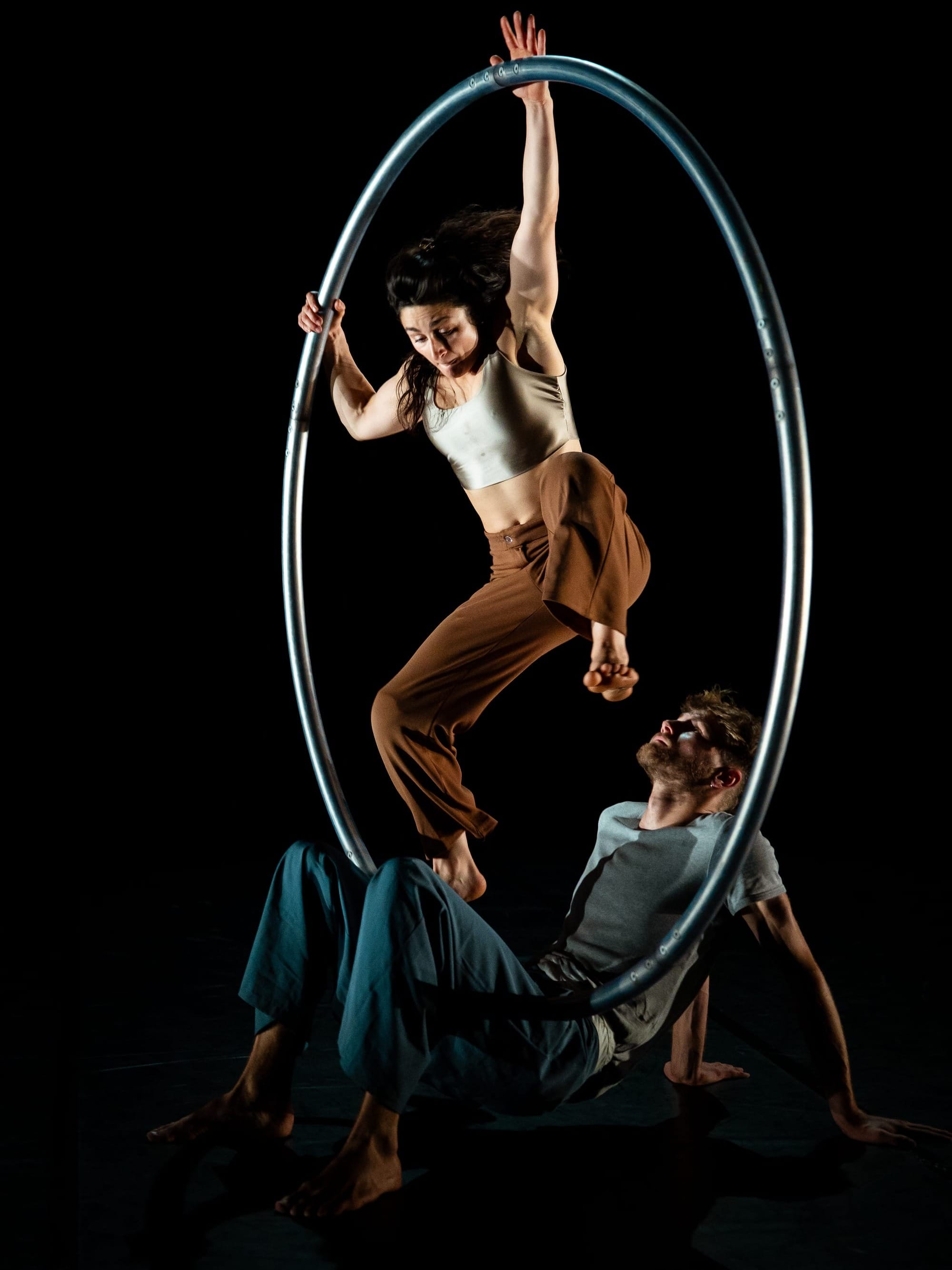
MM: Through the Cyr wheel, I’m able to express who I am and what I want to say: I would struggle to communicate in any other way. I find that offering your body on stage is an act of generosity, a moment when you give yourself to others, evoking emotions in those watching you.
JE: Although we had the same teachers and shared the same working methods, it is clear that we have a completely different approach to the apparatus. Marica speaks more from an instinctive point of view and has a more emotional and dynamic approach to technique. For her, the wheel is at the service of the body. I am more reflective and approach the wheel as an object manipulator would, because I come from a juggling background. My insights stem from reflections on how the wheel moves, rather than from a movement and its reaction. I put my body at the service of the object: with my body, I try to make the object do things, rather than having the object make my body do things.
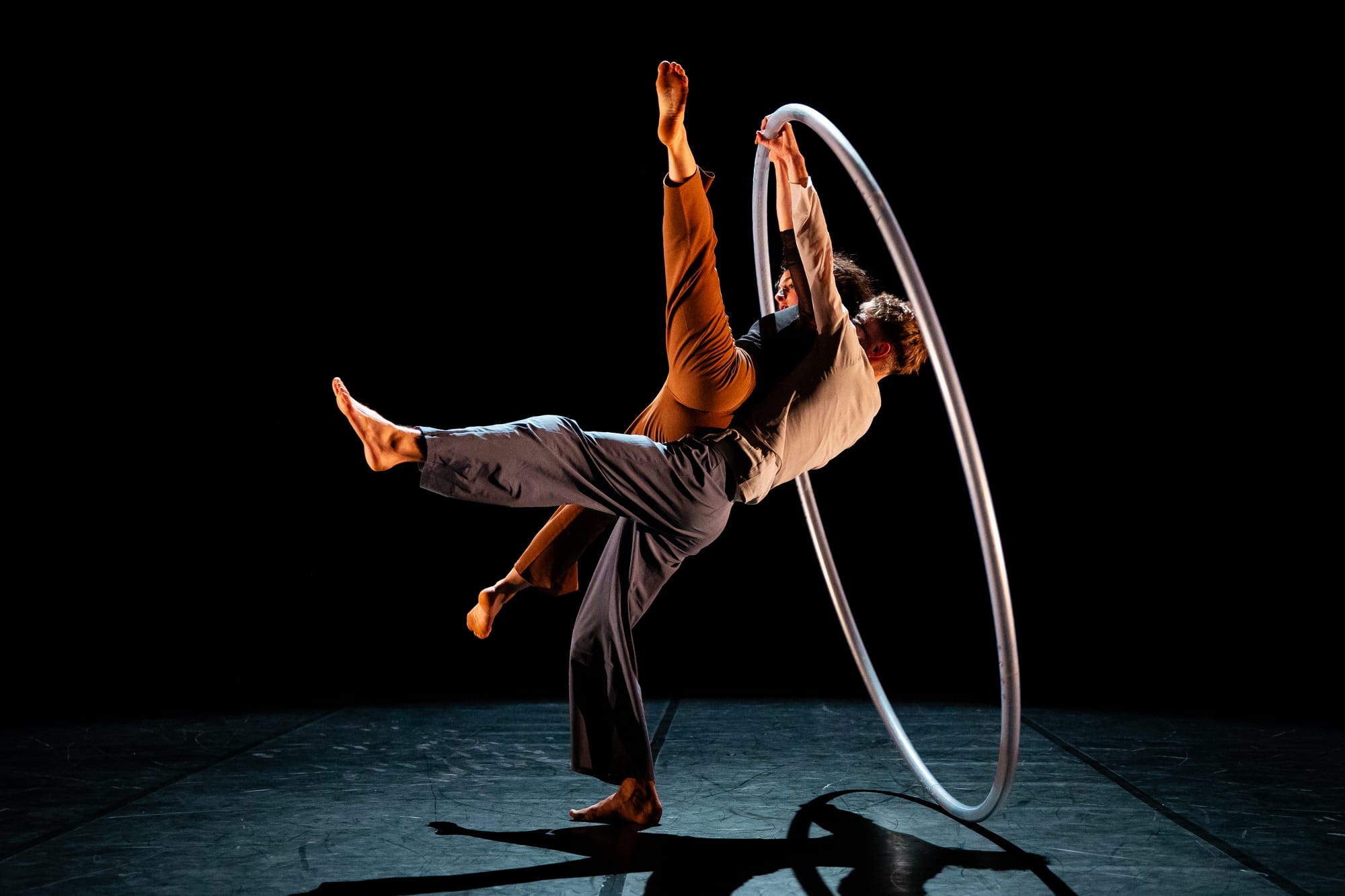
MM: In other words, I use the wheel and gravity to make my body appear to be flying, while Jef uses anti-gravity to suspend the wheel in space-time.
JE: Even if I can identify myself strongly with this state of stillness, for me, interacting with the wheel is not just about balance. During Flic and CNAC, I began observing other artists, particularly jugglers, asking myself what I particularly liked about their technique and how it might influence my own. Manipulation, balance, and contact were already the basis of the things I worked on. One day, I saw Marianna De Sanctis during an improvisation with the hula hoop, and realised that the same movement and the resulting balance of the object on the body could also work with the Cyr wheel. A contemplative imagery immediately opened up to me, in stark contrast to what one usually expects from its use. It was like gaining access to a new physical vocabulary and concepts that I could bring to the stage.
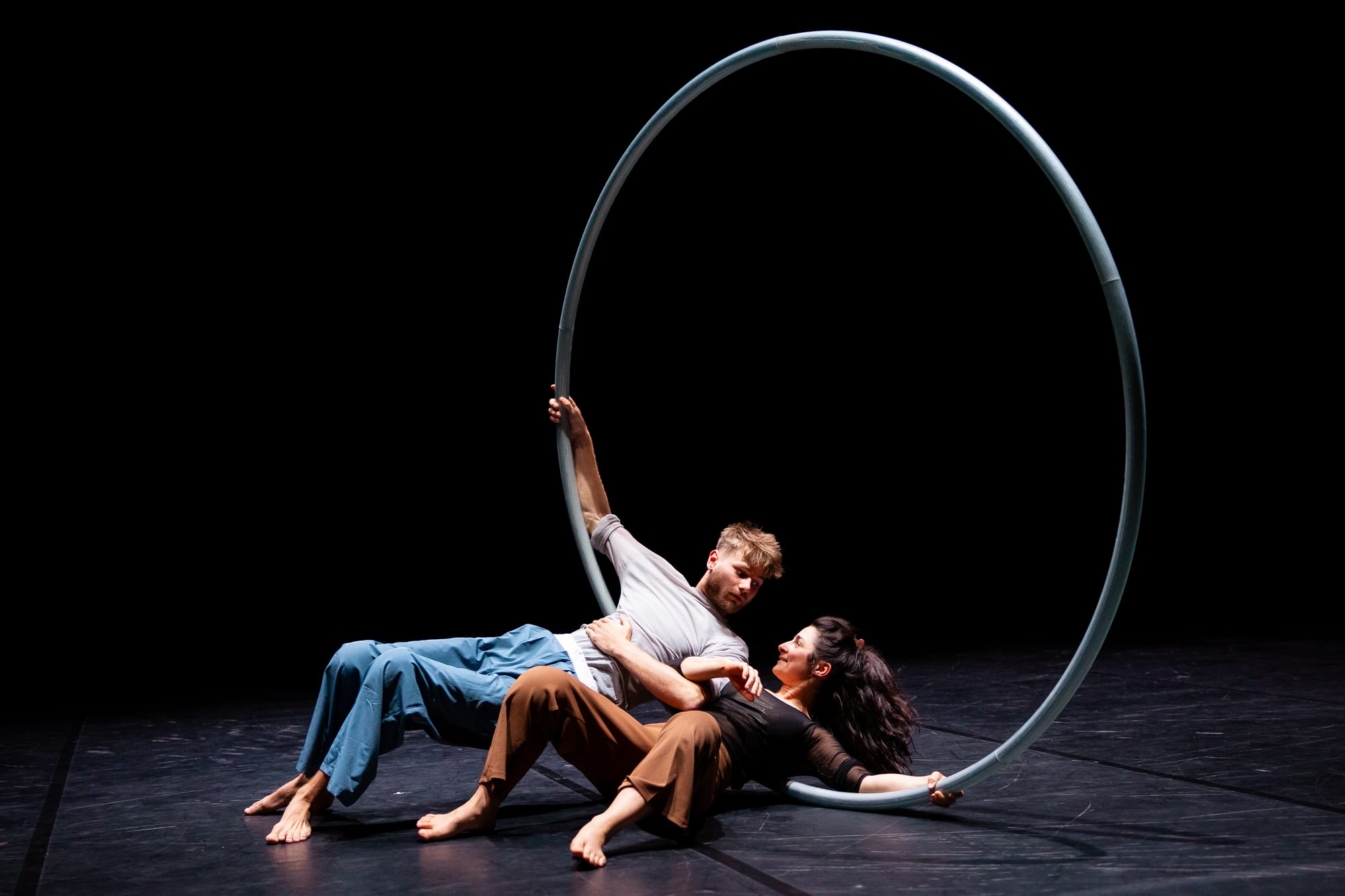
What led you to discover the creative journey of In Difference?
MM: Our collaboration stemmed from our shared passion for the Cyr wheel itself, combined with a deep mutual respect. Having seen Jef’s solo project, the initial idea was to revisit the setting he had devised for his project and see how we felt working together there, because at first it seemed to us that there was room for both of us. Yet, the further we progressed in the process of creating the show, the more we realised that Jef’s setting was a false lead. The tree on stage, for example, was very limiting; it belonged more to him than to me, and in this we were not equal. Its presence prevented us from creating something from scratch, something that was entirely ours but built from a starting point of equal possibilities.
JE: We needed to start with a blank page that belonged to both of us. Now, the balance we’ve found for In Difference is all the materials we’ve worked on together from the very beginning. Adding dynamism and stillness to both of our individual practices has allowed us to push our individual research further and turn it into shared ground. We wanted to go beyond our technical limits and amplify them through our relationship with one another. The performance has this quality: it creates osmosis within difference and individuality within shared ground.
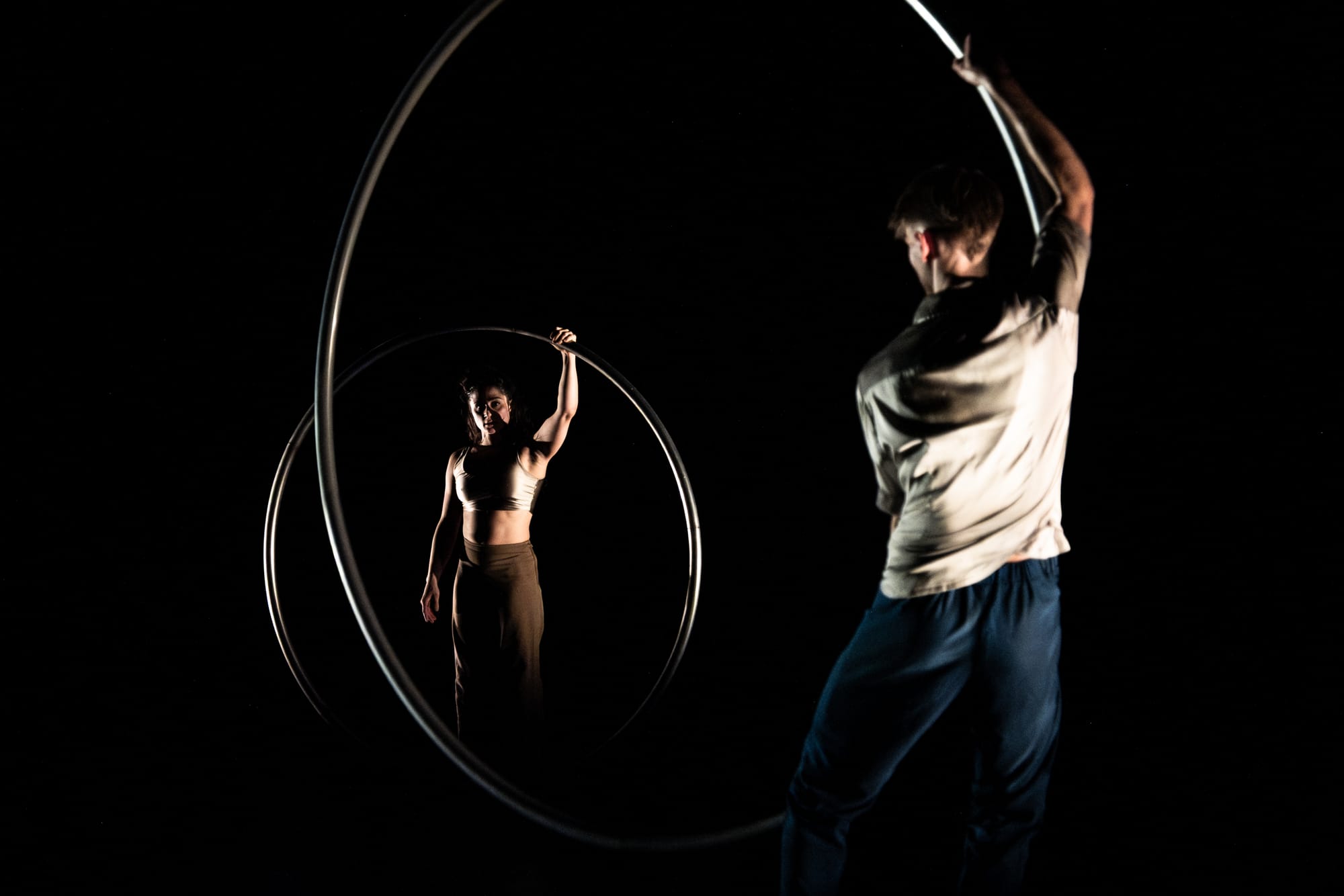
Which other artists have been involved in this project?
JE: Francesco Sgrò, who also composed the music, was one of the first people we brought on board as an artistic collaborator in the broadest sense. The decision to work with him felt natural because he already knew us well and understood how to deal with our different approaches, personalities and needs.
MM: We also brought in Juan Ignatio Tula, primarily to work on the physical material, and involved Alexander Vantournhout for the overall dramaturgy, who helped us confirm the order of the scenes to achieve a conceptual and sensitive result.
JE: When you learn a basic move and perform it repeatedly, the magic of doing it fades, yet the surprise remains for those watching. Some things seemed ordinary to us, but they aren’t to the audience. Sometimes you need someone outside your circus know-how to see you perform and help you understand what you’re trying to express in a narrative sense.
MM: Where a simple rotation might seem superfluous to us, it is at that very moment that the audience breathes a sigh of relief and the energy rises. From a dramaturg’s perspective, the attempt to balance on the wheel together highlights our desire to connect with one another and our failure to do so. A simple movement is important because it also represents the first step in a variation; it is the first element of a technical language that you will see evolve. This is why it seemed right to us to involve people from outside the circus world, such as Marie Ballet and Guillaume Servely, to make our language accessible even to those unfamiliar with the circus and the Cyr wheel as such.
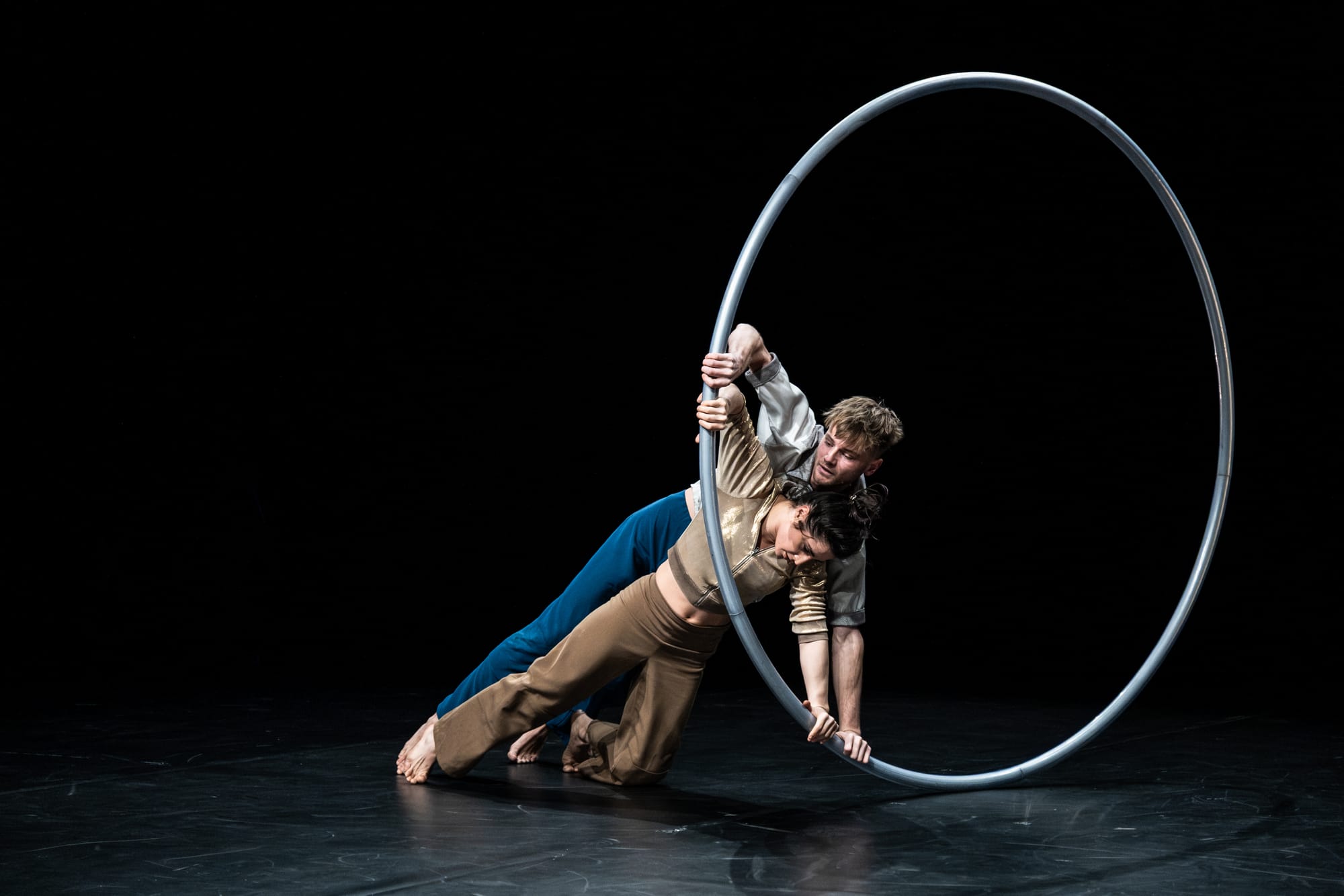
How did the circusnext laboratory support your creative process?
JE: We participated in the laboratory in Serbia run by Cirkobalkana, and the experience gave us the chance to work in a way that was less technical but more focused on understanding what we wanted to express on stage. Working together during that workshop gave us a new sense of depth.
MM: It made us aware of what we have in common, as well as our differences. This is extremely valuable because when you want to address diversity, you have to look at it from every angle, including its opposite: togetherness.
Since the beginning, the technical side was already there, we had got the hang of it, and everything was going well, but the bond between us came later. At the start, there was a sense of osmosis, which then expanded thanks to a slow process that allowed us to focus on one another. It was as if we were technically too close to be able to see our differences. The creative process taught us that getting to know one another is not a given, nor is discovering how and in what we are different.
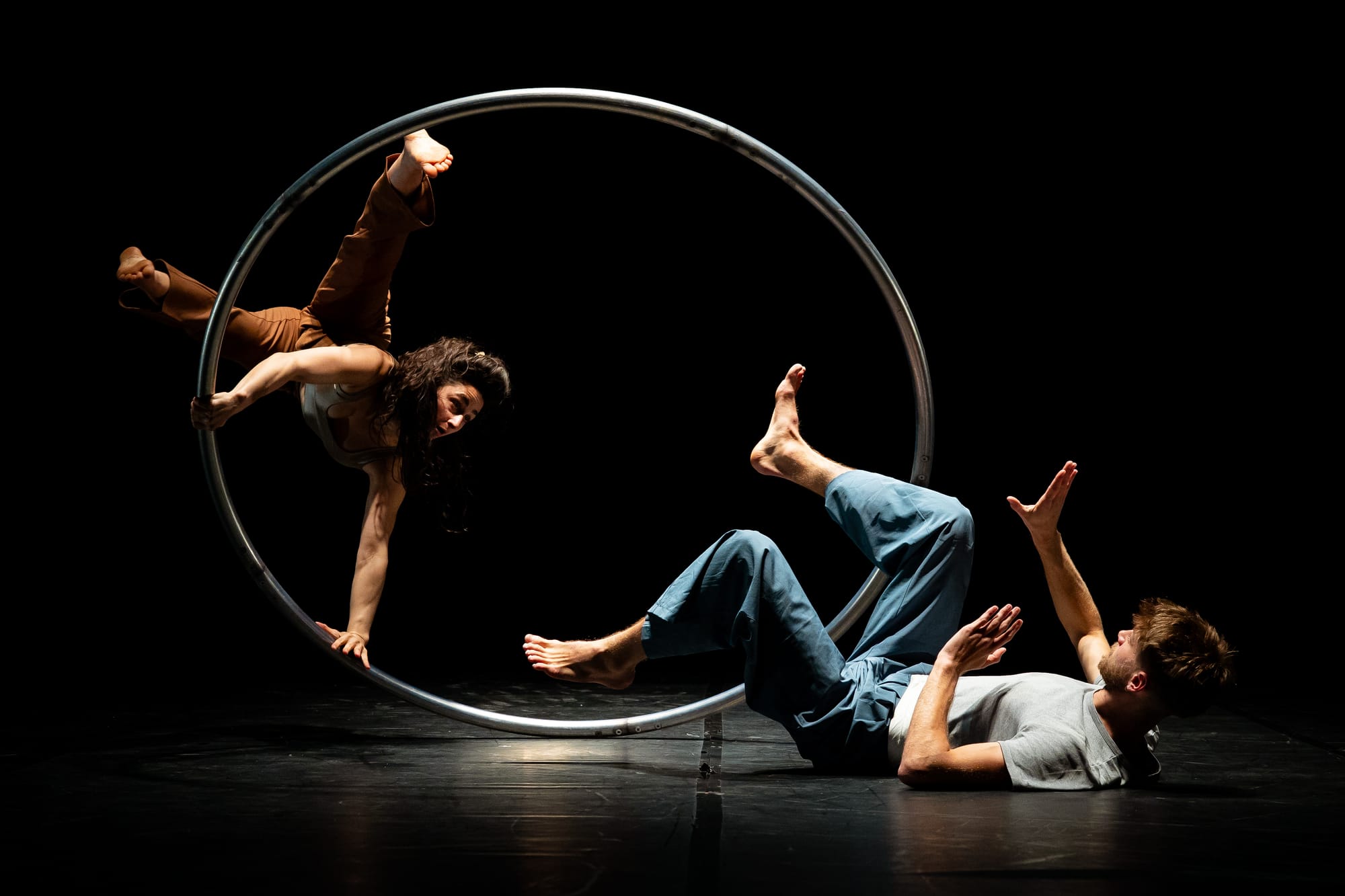
Your stage presence is like a statement of personality without a specific character. Yet the natural contrast in character comes across powerfully through your stage movements. What challenges have you faced in developing your artistic partnership, and what have you learnt about yourselves, both as performers and as people?
JE: On stage, it’s just the two of us as circus performers. We don’t play characters: it’s as if we were just ourselves, only a bit more exaggerated.
MM: I laugh because my sister, for example, gets annoyed when she sees me on stage, because to her I’m very much like my real-life self on stage; she says I’m predictable, that she recognises me as a person.
JE: Before I got started on this project, I used to work with people who had a similar creative approach, whereas Marica and I work differently.
MM: For me, there is always a creative quality in facing something unfamiliar. For Jef, conflict is a shock, and he avoids it at all costs. Yet the theme of difference originated with him and has enriched the project enormously. We had an idea for the show, and we relaxed rather than trying to dominate the other or impose our egos. Let’s say we worked towards a collapse of the ego for the greater good. From Jef, I learnt humanity. I realised that sometimes, by remaining kind to people, things evolve and often resolve themselves. And then I saw that every conflict made us grow; there was always a marked improvement; confrontation became our strength.
JE: Everyone who knows us individually is now surprised when they see us on stage and tells us that we look more alike. I am now more like Marica in the way I perform, and Marica is more like me. For me, this means being more in touch with the pure movement and the world of abstract choreography; for her, it means being more in contact and exploring the potential for humour and theatrical play. For both of us, the project represents the freedom to explore many styles and experience a human connection. From Marica, I have learnt that if you want something, you have to go and get it, and that sometimes you can be more persistent, stand up for yourself a bit more, not accept things you don’t want to accept, stay in the process, take care of things, and be more active and practical about the things that need to be done. We’ve both learned how to be project leaders together.
What plans do you have in the making for the future?
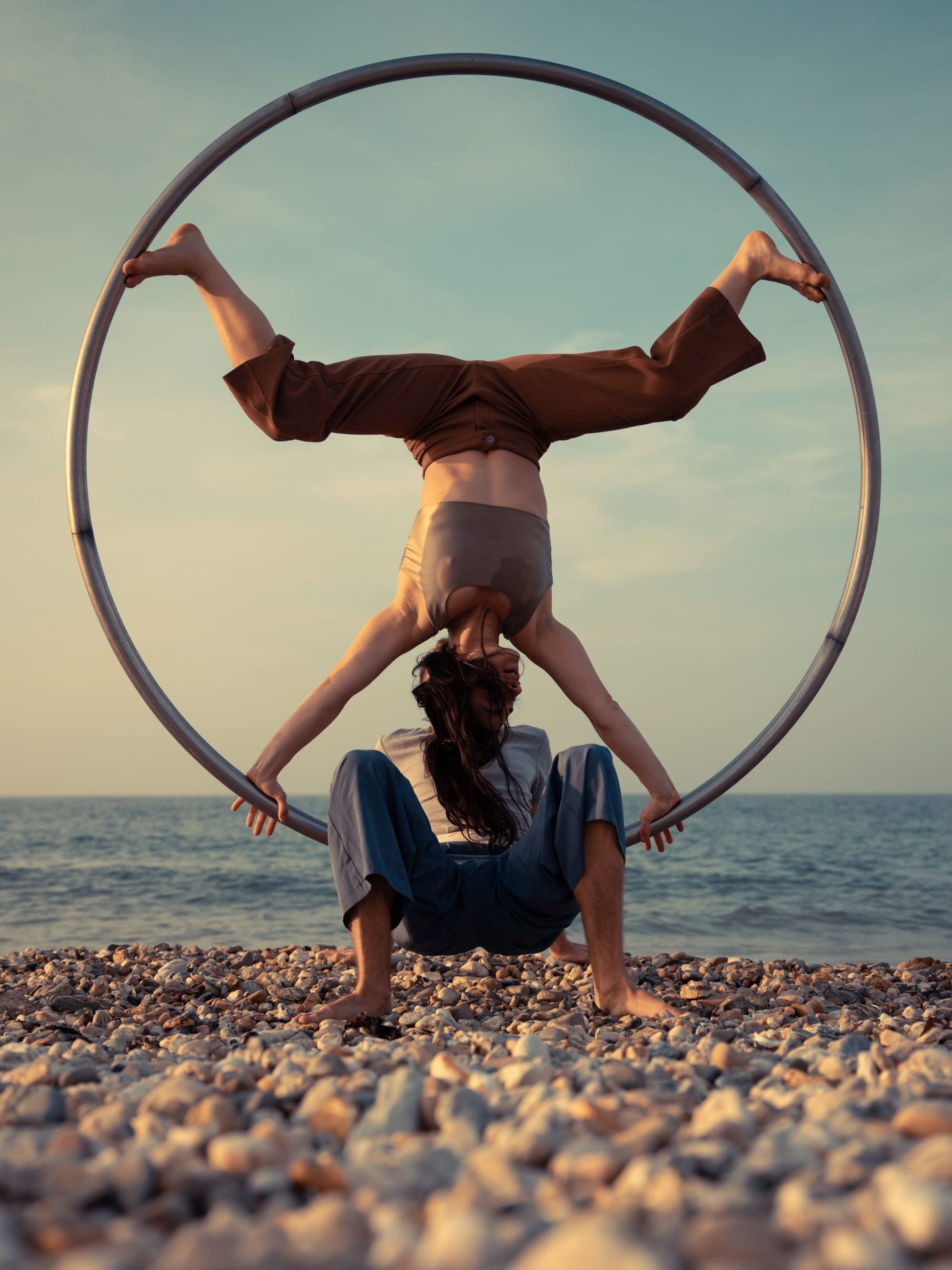
MM: We are a duo collaborating on an artistic project, but we have maintained our individual identities whilst working together, without setting up a company. We want to take the project on tour as much as possible. In Difference is currently our priority. From my experience, I know it is entirely feasible to make room for other individual projects as well, which will undoubtedly enrich our stage presence.
JE: Given that the performance draws on a very broad artistic vocabulary, we can extract specific sequences, which allows us to be flexible and experiment. We want to work with a live musician and create an outdoor, site-specific version of the project. It will be interesting to develop a format suited to a site that is different each time, an aspect that will undoubtedly enable us to expand our artistic language even further.